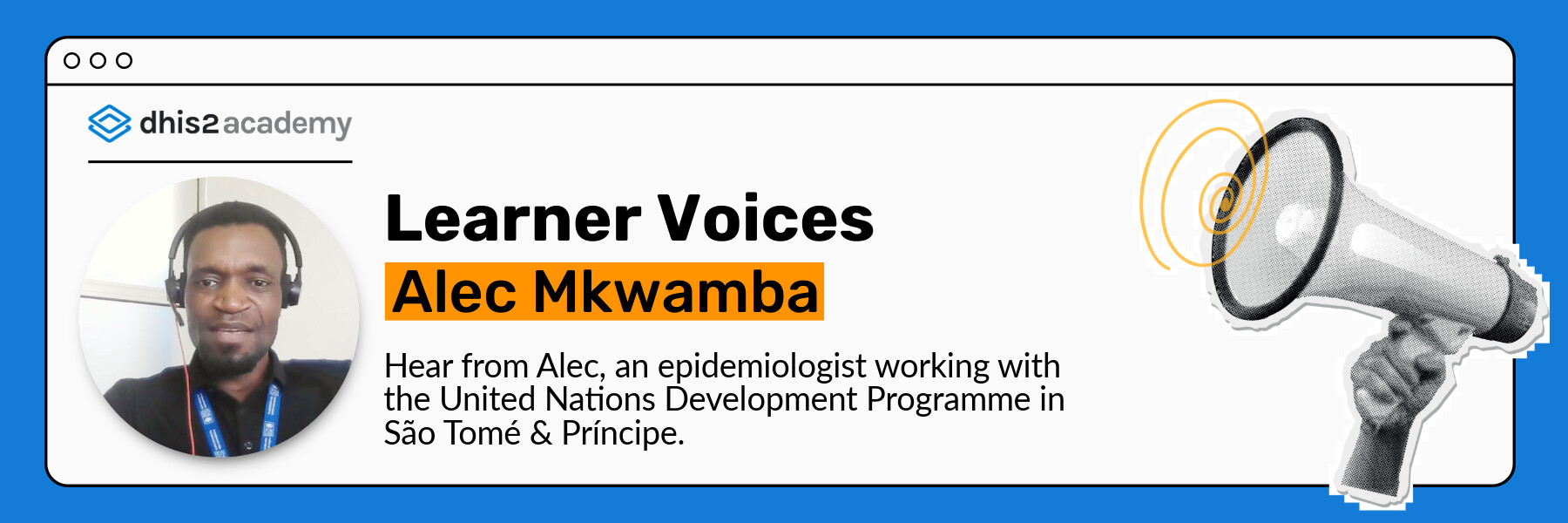
Welcome to the DHIS2 Online Academy “Learner Voices” series! We interviewed the most active learners from the Online Academy, and asked them to share their thoughts about the courses they have taken, and how they have used their knowledge to build capacity, support their organizational goals, and grow their own careers.
In this post, you will hear from Alec Mkwamba @Lex_AK , an epidemiologist currently working with the United Nations Development Programme in São Tomé and Príncipe.
To learn more about the Online Academy, click here.
Q: Please introduce yourself—your name, job title, and organization.
Hi, my name is Alec Mkwamba. I’m an epidemiologist currently working for the United Nations Development Programme (UNDP) in São Tomé and Príncipe.
Q: Why and when did you first start taking courses on the Online Academy?
I was assigned to São Tomé and Príncipe as part of the COVID-19 response. UNDP recruited international experts in different areas, and I was assigned to assist as an epidemiologist. Part of my work was supporting the application of DHIS2 in the national health information system as they transitioned from paper-based to electronic. I also needed to help introduce and utilize electronic COVID-19 modules—contact tracing and case management—within DHIS2. To do that, I needed to familiarize myself more with the system, so I started taking the DHIS2 Online Academy courses.
Q: You’ve become one of our most active learners. What motivated you to continue taking multiple courses?
I took the first course and found it interesting. As the pandemic came under control, my focus shifted from disease surveillance to supporting the rollout of DHIS2 in general. UNDP supported the Ministry of Health in launching DHIS2 and implementing it—from aggregate data to individual Tracker data. As my job shifted, it was reasonable to explore more online courses.
Q: Many people struggle to stay engaged in online courses. What kept you engaged—course material or job need?
Both. The courses were genuinely interesting, and there was a real need to learn. Also, I wanted to motivate others. I’m an English speaker working where Portuguese is primary, so colleagues faced an extra barrier with course language. If I didn’t complete courses without that barrier, it wouldn’t be exemplary. The first course gives a broad overview that motivates you to take focused courses. My background—epidemiology and international health systems with appreciation for data—also made it engaging. So: interesting content, professional need, and setting an example.
Q: Which features mattered most—the exercises, videos, or completion certificates?
The certificate is the icing on the cake. The real value is the design: lectures that explain concepts, followed by lab sessions on a training instance that mimics a real database with fictional data. You actually practice what you learned. The videos are strong—clear narration with corresponding visuals—and doing the tasks builds the practical “motor skills.” Tests/exercises with pass marks keep it engaging. That structure makes the courses comprehensive.
Q: Practical suggestions for people who struggle to finish online courses?
Challenges vary. In some contexts there are logistical barriers: internet, electricity/power cuts, devices with weak batteries—five-minute tasks can take fifteen and become discouraging. Where possible, get logistics right to avoid distractions. There’s also learning culture—some aren’t familiar with online learning. We held motivation sessions explaining advantages and addressing concerns. It helped people appreciate online learning and be ready to undertake it.
Q: Are you working primarily with ministry-owned systems or an internal system?
Ministry systems—specifically in the health sector. We’ve discussed expanding to other sectors, but focus has been the Ministry of Health.
Q: In São Tomé, tell me about the system: aggregate vs. Tracker, data types, etc.
UNDP’s global strategy emphasizes priority development areas with digitalization as an enabler. The government’s interest in digitalization aligned with UNDP’s approach, so we supported digital solutions across sectors, including health.
For health, support included transitioning from paper-based to electronic HIS using DHIS2 as the primary platform. DHIS2 was launched in 2019, initially for aggregate data (monthly reports, weekly disease notification), then gradually expanded to Tracker for priority programs—HIV, TB, malaria, and COVID-19 contact tracing and case management. We’re also implementing a unique patient file (“processo único”) to link all patient data across programs so a person’s history is connected regardless of module.
Another challenge was system fragmentation—different programs using different electronic systems. The government decided to establish DHIS2 as the primary data system. Only if a compelling reason exists would another system be used, and it must be interoperable with DHIS2. We’re expanding DHIS2 across programs and ensuring interoperability where necessary.
Q: Give a brief example of how something you learned in the Online Academy helped you solve a challenge.
We recognized DHIS2’s potential via the online courses, but local uptake of online resources was limited by language. After enabling staff to undertake the courses, we saw clear changes: technicians could perform customizations that previously required international consultants, and they started creating their own modules—for example, an asset registry for the Ministry of Health and a maternity module linked to the existing child immunization Tracker. These shifts came directly from knowledge gained in the courses.
Q: What concrete impact have those new modules had?
For maternity: previously, the immunization program struggled with true targets. Children are registered in immunization weeks after birth, and census-based targets can be outdated. With the maternity module, newborns are registered at birth. Linking maternity to immunization gives a better denominator—a more accurate estimate of the target population for immunization—improving planning and monitoring. Not all births are facility-based, but many are, so it substantially improves confidence in targets.
Q: Have you seen reductions in missed vaccinations yet?
We expect that outcome, but the maternity module started this year, so we still need time to measure impact. Theoretically, registering at birth should reduce missed vaccinations, but as an epidemiologist I’d want evidence before making that statement.
Q: Has DHIS2 changed your career path or responsibilities?
Yes. I’ve worked in more research-oriented roles before, but DHIS2 shifted my focus toward health information systems—one of the health system building blocks. It redirected my work to strengthening HIS, which I see as foundational for strong health systems.
Q: Beyond your role, have your DHIS2 skills influenced UNDP or Ministry goals?
Yes. From the 2019 launch to about 2023, local capacity improved but could have gone further. We sought to accelerate capacity using the Online Academy, addressing barriers (notably language). We mobilized health workers, translated/adapted materials into Portuguese, and ran hybrid workshops where participants completed online courses with on-site internet, power, and orientation.
Results: stronger foundational knowledge among local managers and users; requests to international experts are now at a higher level; local teams operate at a higher level and accelerate implementation. As people grasp what DHIS2 can do, they demand more, which pushes everyone—local teams and external experts—to raise their game.
Q: What’s the most important value the Online Academy offers?
Its comprehensive structure: it gives the big picture before focusing on specifics—within courses and within modules—so after finishing, you’re more aware of capabilities and motivated to apply them. Compared with many in-person workshops that can be narrowly focused, the Academy balances breadth and depth.
Q: So you’d recommend the Online Academy to colleagues in digital health or information systems?
Definitely.
Q: Anything to add or ask?
On translations/adaptations: we extracted captions from the English courses, translated them into Portuguese, used AI voiceovers that sounded natural, then synced them to videos—sometimes adjusting segment speeds due to language length differences.
On the hybrid approach: to mitigate barriers (internet, electricity, noise, unfamiliarity with online learning), we organized in-person workshops where each person completed their own online path with stable infrastructure and a short platform orientation. This proved very helpful and could benefit other countries with similar constraints.
The online courses provide a solid foundation so participants get more from in-person academies and expert interactions. As Einstein said: “The more I know, the more I realize how much I do not know.” These courses raise demand for advanced capabilities and drive innovation across the DHIS2 community.

